


You can get how much in that single-engine? Astro Aero unveils A200C SkyExpress
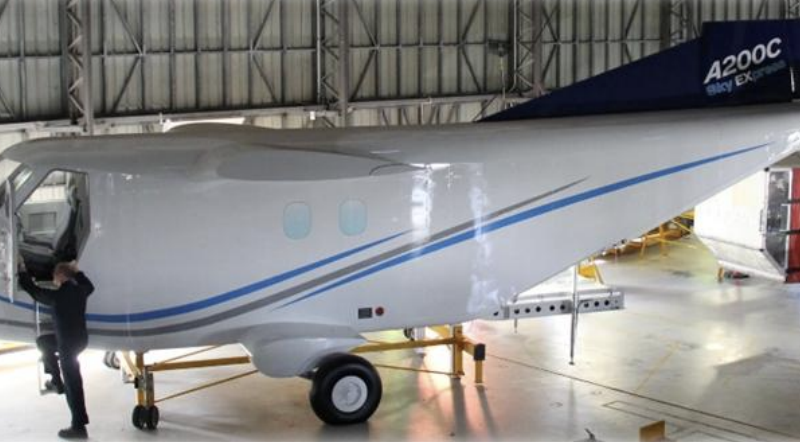
The prototype in build at AstroAero's development headquarters in Hervey Bay, Queensland, Australia.
Coming up with an aircraft design on paper is the easy part. Ask a former Michigan Tech student who, in 2015, conceptualised an entire wing-in-ground effect craft on paper and whiteboard after a night out. He woke up in the morning with no memory of his exploits.
Developing, certifying, producing and supporting the aircraft is the hard work. Certification can extend to the best part of a decade, accumulating thousands of ground test and flight hours. This is the reality for everybody, even large OEMs that have done it all before.
Australian aircraft maker Astro Aero is not put off by the challenge. It has recently unveiled its A200C SkyExpress, a single-engine cargo utility aircraft designed to “bridge the gap between large, hub-bound air freighters and remote, small-market destinations”.
The A200C will be among the very first aircraft of its class to leverage the flexibilities of the recently modernised airworthiness standards in Part 23 of the US Federal Aviation Regulations, to field a single-engine utility cargo aircraft of this scale.
“By maximising these modern regulatory frameworks, Astro Aero will deliver a platform that injects unprecedented economic efficiency into a sub-15,000lbs aircraft,” Daniel Rich, chief test pilot at Astro Aero tells Aircraft Investor.
Its dimensions are impressive for a single-engine. The SkyExpress boasts a wingspan of 66.7ft (20.3m) and is 50.2ft (15.3m) long. For comparison, the Cessna SkyCourier – a twin-engine – is 55ft 1in (16.8m) long and has a wingspan of 72ft 3in (22.02m), and a Cessna Caravan is 37ft 7in (11.5m) long with a wingspan of 52ft 1in (15.9m).
The A200C will also be fully IFR approved and certified to fly into known icing. “In addition, because we are utilising Part 23 the aircraft will be single-pilot,” says Rich. The unpressurised aircraft will have a maximum operating altitude of 25,000ft (7,620m) with supplemental breathing oxygen, he adds.
Power for the aircraft will come from a Pratt & Whitney Canada PT6A-67T; Hartzell has designed and manufactured a bespoke five-blade composite propeller capable of constant-speed, feathering and reversing; the cockpit will feature the Garmin TXi avionics suite; and MEMKO Australia has produced the landing gear.
Astro Aero has also worked extensively with The Loads Group and the University of Washington’s Kirsten Wind Tunnel to refine the aerodynamic design.
“While many modern clean-sheet aircraft designs lean heavily into complex, expensive carbon-fibre composites, Astro Aero is taking a highly pragmatic, market-driven approach to production,” says Rich.
The A200C is being designed and built using conventional materials and traditional sheet metal techniques. “By bypassing the specialised autoclaves, temperature-controlled storage and costly repair protocols required by most composite airframes, Astro Aero ensures the SkyExpress will be highly affordable to acquire and simple to repair,” he continues.
This means if an airframe suffers minor ramp rash or field damage at a remote regional hub, local mechanics can perform standard sheet metal patches.
The draw of the door
At the heart of the SkyExpress is the cargo door and self-levelling legs. The aperture is 65in (1.65m) wide and 71in (1.8m) high. It is not much smaller than the rear cargo door on a Cessna SkyCourier which is 87in (2.2m) wide and 69in (1.75m) high.
“Recognising that regional infrastructure is frequently subpar, our ramp and door system integrates hydraulic, self-levelling support legs built into the ramp assembly,” says Rich.
This eliminates the need for ground-based tail stands or specialised ground support equipment during turnaround cycles. The self-levelling legs adjust to stabilise the aircraft on uneven terrain or unpaved runways, accommodating centre-of-gravity shifts as heavy cargo is rolled across the ramp.
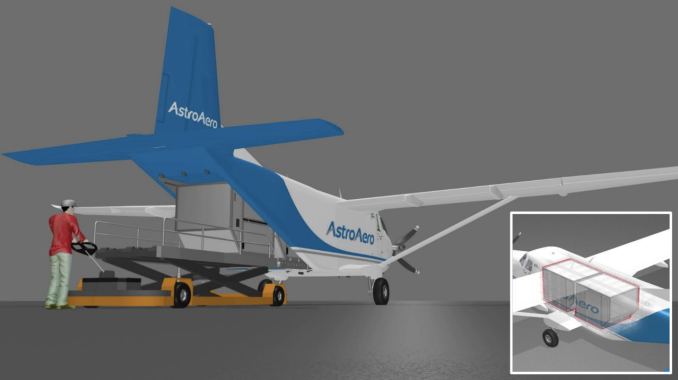
“When this is combined with our generous loading aperture and large cargo volume, operators can mix, match and transport a massive variety of containers,” says Rich. The SkyExpress is compatible with Load Device (LD) 1, LD2, LD3, LD3-45, LD4, LD6, LD8 and LD11 units (for those familiar with cargo transit). It also accepts any standard half-pallet configurations up to a maximum individual position mass of 3,750 lbs (1,700kg).
The aircraft will have a maximum take-off weight of 14,500lbs (6,577kg), and be able to carry 5,500lbs (2,494kg) of cargo and 3,800lbs (1,723kg) of fuel.
‘Primitive airfields’
The Astro Aero team is aiming for a take-off ground roll of less than 1,500ft (457m). The design also combines high ground clearance with a robust landing gear configuration, meaning it will be able to access unprepared and rough fields. “This unlocks access to a much wider range of primitive airfields previously unreachable by aircraft of this payload capacity,” says Rich.
Astro Aero is staying tight-lipped on certification timeline for now. The concept design goes back to 2016; today, the team has built a full scale mock-up and is currently assembling major components.
“Assembly of our wings and main fuselage is underway in our prototype development headquarters in Hervey Bay, Queensland, Australia,” says Rich.
Astro Aero is focused initially on selling SkyExpress to the freight feeder market. “Companies like FedEX and DHL experience large and costly delays at their large freight airports where containerised cargo needs to be unloaded, broken down, sorted, then re-packed on small aircraft or onto land-based transport,” Rich explains.
Rich says SkyExpress eliminates much of the bottleneck suffered by the likes of FedEX and DHL. “First, we can accept the containerised cargo – eliminating the need for the unpack, re-sort, re-pack delays and handling costs. Second, we are far more efficient than current aircraft as we can carry more, using a single engine,” he says. Astro Aero’s projected costs are US$1.76 per ton per nautical mile.
‘Familiar glass cockpit’
To control pilot training costs and accelerate time-to-market, Astro Aero has selected the Garmin TXi avionics suite as the primary flight deck architecture. Integrating this familiar general aviation glass cockpit layout serves a critical commercial purpose: it matches the flight-deck experience of modern flight schools.
“Operators can recruit newer commercial pilots coming straight out of flight academies and transition them into the A200C cockpit with minimal type-rating delays or training overhead,” says Rich.
This “smooth” transition pathway is further reinforced by extensive aerodynamic refinement. “As an experienced test pilot, I have personally overseen the comprehensive physical wind tunnel testing and aerodynamic and control design,” continues Rich. “I am confident the A200C will be a forgiving and pleasant aircraft to fly while remaining simple to manufacture and maintain.”
It might not be clear on when the aircraft will enter service, or how much is required to fund the remainder of the programme through to certification, but when complete it “will be the largest aircraft ever [privately] designed and built in Australia”, says Rich. It might also be the greatest disruptor in the sector since the Cessna Caravan, with a cargo door a PC-12 would be very proud of.
Subscribe to our free newsletter
For more opinions from Aicraft Investor, subscribe to our One Minute Week newsletter.