


Composing marginal gains
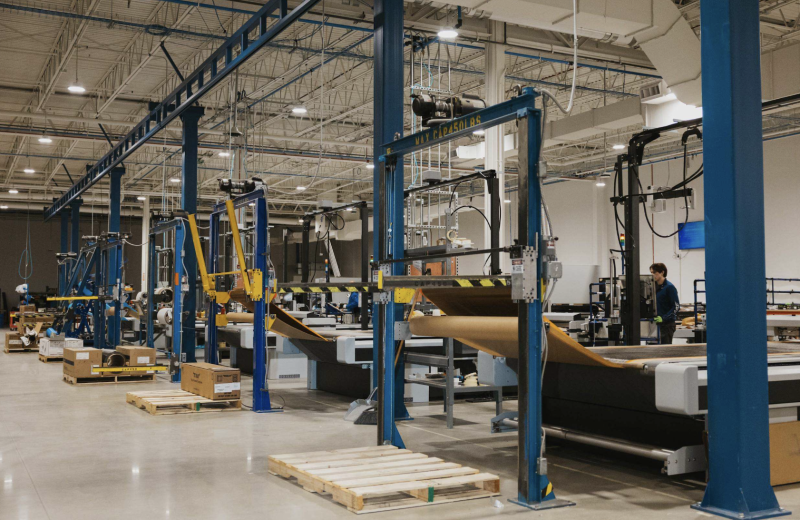
Cirrus Aircraft's expanded Grand Forks facility officially opened on August 14th, 2026.
For elite cyclists, track athletes and Formula One teams, marginal gains are everything. A few hundredths of a second can mean winning it all or missing the podium.
It is the same for aircraft manufacturers. The materials used to build airframes and components are a great example. From early aircraft constructed of fabric and wood to all-metal aircraft and composites, the endeavour to create faster, higher flying and longer-range aircraft with increased payload has pushed the envelope of materials science.
Every aircraft Cirrus manufactures involves composite construction, mainly using carbon fibre and fibreglass reinforced with closed-cell foam cores to provide strength. Cirrus is arguably a pioneer of composite construction. Its first aircraft the VK-30, introduced in 1987, was made using composite materials.
This week Cirrus opened its expanded Grand Forks, North Dakota facility. Purpose-built to support current and forecasted production rates, the facility streamlines the movement of composite parts throughout the manufacturing process.
Nadia Haidar, public relations manager tells Aircraft Investor: “Composite material manufacturing is at the heart of Cirrus aircraft production. The plant expansion has enabled us to update the layout for CNC [computer numerical control] machinery, which improves safety, quality and overall production flow.”
The Grand Forks facility has more than 500 staff supporting composite production across the product portfolio. About 80% of the workforce is dedicated to direct manufacturing operations.
“The expansion adds more production space to support increased manufacturing capacity, including the new TRAC10, and we continue to hire across all shifts in Grand Forks,” says Haidar.
Demand is growing for Cirrus aircraft, in 2024 it delivered 731 aircraft (630 SR Series and 101 Vision Jets). Last year it delivered 797 aircraft (691 SR Series and 106 Vision Jets).
Earlier in August, Pilatus opened a centre of “advanced composite competence” in Switzerland, bringing development and production of composite materials under one roof.
“The building unites all the steps in the value chain: from delivery and storage of the raw materials through to component production and subassembly, to surface treatment, storage and order picking,” a Pilatus spokesperson tells Aircraft Investor.
“Fibre-reinforced materials have long been in use at Pilatus, but mainly for non-load-bearing secondary structures such as covers and cowlings. With the PC-24 Super Versatile Jet, for the first time, composite materials are now being used for primary structural components as well,” says the spokesperson.
The facility will develop parts including engine cowling and nacelle components, fairings and aerodynamic covers, as well as wing and fuselage fairings for the PC-12 PRO, PC-24, PC-21 and PC-7 MKX.
The new facility features automated systems, such as prepreg cutting machines and autoclaves. “However, a large proportion of the work still involves craftsmanship and highly skilled labour,” says the spokesperson. “The new production facility also provides an opportunity to explore further automation of production processes.”
Pilatus delivered 147 aircraft in 2025, slightly fewer than the 153 in 2024, driven by supply chain constraints and component shortages. The company expects the new facility will help to streamline its production.
Fabric and wood gave way to metal, which in turn is giving way to composites, because tiny advantages add up.
As former British Cycling performance director Sir Dave Brailsford, who coined the term, says: “Small improvements in a number of different aspects of what we do can have a huge impact to the overall performance.” Aircraft manufacturers certainly subscribe to this school of thought.
Subscribe to our free newsletter
For more opinions from Aicraft Investor, subscribe to our One Minute Week newsletter.