


Second Star has two at the helm
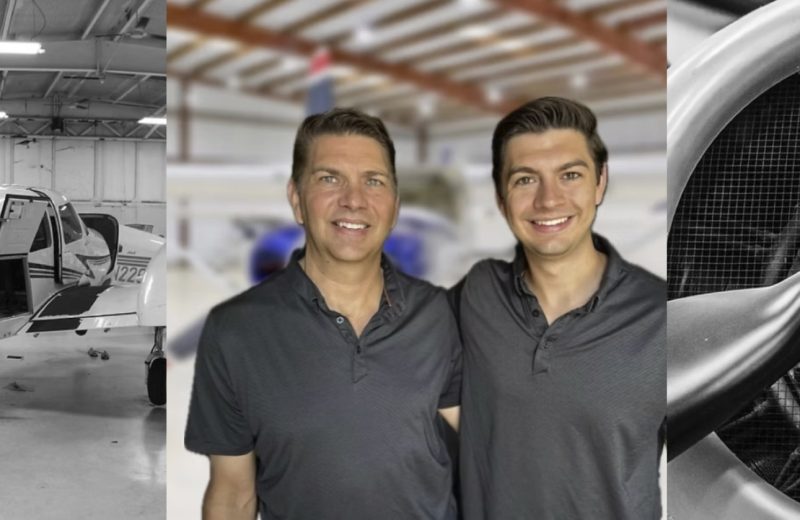
Father-son duo Kevin Goehring and David Freed founded Second Star Aviation in 2024.
Will and Jaden Smith, Tom and Colin Hanks, LeBron and Bronny James. Famous father-son duos tend to capture the imagination.
When The Pursuit of Happyness – starring Will Smith as a homeless salesman and Jaden Smith as his son – was released in 2006 it was a resounding success, grossing $307m worldwide with a $55m budget. Critics widely praised the dynamic between the pair.
Father-son duo Kevin and David Goehring Freed (who prefers to be known as Freed) are two years into their own journey (not discounting the decades Goehring spent raising Freed). The pair founded Second Star Aviation, an aircraft maintenance business, in 2024 with a clear idea: Goehring handles the maintenance, Freed the business.
“Working alongside my dad has been one of the most rewarding parts of starting Second Star,” Freed, who leads as CEO, tells us.
He says many maintenance companies nowadays have a similar story: a great mechanic starts a shop, which grows. Sooner or later that great mechanic finds themselves behind a computer all day trying to run a business instead of managing the work on aircraft.
‘We avoid that problem’
“By partnering with my dad, we avoid that problem,” he says. “He has a great mechanical background. He has spent the last 35 years working on aircraft and the last 10 teaching others how to do it. He can create policies and procedures to ensure safe, high-quality and efficient work.” Goehring is Second Star’s chief maintenance officer.
Freed has a background in business. He spent some time in corporate America at Walmart before attaining an MBA from Stanford. “[Dad] oversees all things maintenance, and I oversee all things business. It’s a great partnership,” says Freed.
As well as establishing maintenance businesses from scratch, a cornerstone of Second Star’s strategy is to acquire the businesses of shop owners. “We help them to retire or pass along the business management of their facility so that the company they built can thrive for decades more,” he says.
“The really great part is that as we grow, our business gets better. We take the best ideas from technicians at one shop and put them in practice company wide.”
The first of these acquisitions is nearing close with an announcement on the way.
We are always on the hunt for more deals that could be a good fit, and we have a pipeline of a few that I’m really excited about,” says Freed.
When looking at potential businesses to buy, Second Star looks at the people running that operation above all.
‘Protect their safety’
“We are looking for great technicians with great customers who want to do a great job,” he explains. “There are a lot of strong opinions in general aviation. We want technicians and customers who want to partner to protect their safety and their investment in their aircraft.”
Maintenance might be the name of the game, but Freed says Second Star views itself as a partner in aircraft ownership – “not simply a hangar where you drop off your plane”.
“We want to help guide maintenance decisions, respond to last-minute repair needs and expand our services to provide greater value to our customers,” he adds.
Second Star’s first two years have not been without challenges. Freed says many of these are “rewarding”, but the most frustrating has been the lack of hangar space for maintenance shops.
‘Trucking warehouses’
“Some airports have been pretty explicit that they do not want maintenance on their field and they’re converting all their large hangars to trucking warehouses,” he says. “It’s a shame to see aviation space be used by non-aviation business.”
But it hasn’t stopped Freed and Goehring from growing the business and training new talent. “We try to create an environment where technicians can take pride in their work, never feel pushed to cut corners and can go home relaxed,” says Freed.
“I hope we can keep growing and expanding our footprint while maintaining a culture where people enjoy their work. In the two-plus years since we started the company, only one technician has left the company. If we can keep that retention rate, I will consider this a success.”
The company has another duo on the staff. Freed’s dogs – aka canine co-pilots – Milo and Kida who “love flying”. Luckily for Freed and Goehring, talent retention has been so strong there has been no need to train them as mechanics.
“I love my dogs but they take up enough of my attention during the non-workday with their high energy,” says Freed. “I’m not sure I could keep up if they started wrenching.”
Subscribe to our free newsletter
For more opinions from Aicraft Investor, subscribe to our One Minute Week newsletter.