


‘I don’t have any tattoos, but if I did it would be a PC-12’
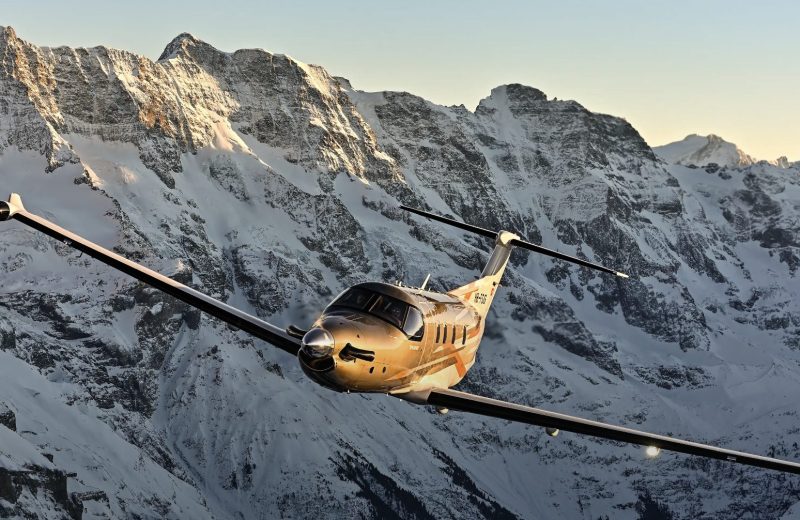
Pilatus has certified five updated variants of the original PC-12.
Just over 35 years ago, on May 31st, 1991, the Pilatus PC-12 took to the air for the very first time.
It wasn’t a delivery, or a customer flight. It was a Pilatus test crew, flying an unproven airframe with a belief that a single-engine turboprop could do what people insisted only twin-engines could at the time.
“I don’t have any tattoos, but if I did it would probably be a Pilatus PC-12,” Phil Winters, vice president, Aircraft Sales & Charter Management at Western Aircraft, which serves as the largest authorised dealer for Pilatus in the US, tells us.
A Pilatus dealer for the past 29 years, Winters joined Western Aircraft in 1997, a year after its partnership with the Swiss aircraft maker began. (The PC-12 was certified in 1995). The dealer has sold nigh on 295 new PC-12s over that period, as well as about 100 pre-owned models.
Western Aircraft also has a management company, operating 16 PC-12s from Hawaii to the western US on its commuter air carrier certificate.
“I think if I had $100m in the bank, I would buy a PC-12 myself because it’s useful,” says Winters, who has 2,200 hours flying the aircraft. “Absent a 4,000 nautical mile mission, it just does everything well across the board.”
On that first flight no one predicted the PC-12 would have the strongest residual values in business aviation, but 35 years later and models typically retain at least 80% of their factory value after a decade.
Pilatus is privately owned and debt-free. Winters believes not having “to report to Wall Street” means the company has been able to only build the right number of PC-12s every year. “We’ve never been in a situation where there were 25 whitetails sitting around in somebody’s inventory unsold,” he says.
In parallel, pricing integrity has remained strong. “Pilatus has always made sure that the airplane was appropriately priced for the market,” Winters continues. “Prices would only increase if there were product improvements that warranted it. You then don’t have to discount to get rid of older models which honours those who already bought the airplane.”
Pilatus’ success as a military manufacturer also helps. Its PC-21 is the backbone of military pilot training for Switzerland, Australia and France among others.
“If Pilatus can’t make as many PC-12s as it wants because the market’s turned down, they’ve always had that supplemental gain from the military business,”he says.
Winters admits he is “heavily biased”, but it is hard to find anyone today with something bad to say about the PC-12. In the early days people took some convincing though.
“In the ‘90s it was a much more difficult sale to convince people that one engine was the right answer,” he recalls. “We spent a lot of time in the early days educating people on the safety of single engine aircraft, and specifically the [Pratt & Whitney Canada] PT6 reliability in the power plant, as well as the PC-12’s extremely effective glide ratio and the construction methods that the Swiss undertook engineering the aircraft.”
“I can’t say enough about not only what they came out with 35 years ago, but what they have continued to improve over that time,” adds Winters.
Pilatus has certified five updated variants of the original PC-12: the PC-12/45, the PC-12/47, the PC-12 NG (PC-12/47E), the PC-12 NGX and, most recently, the PC-12 PRO – certified by EASA in December 2024. “Simply put: [it is] the most advanced single on the market,” a spokesperson for Pilatus tells us.
In his first interview for the job at Western Aircraft, Winters got to fly the aircraft. “I realised on that flight that Pilatus had engineered simplicity. The automation, even in the mid-90s, was head and shoulders better than anything else I had ever flown,” he says.
“It is not just an aircraft that you can fly single pilot, it is a purpose-built single-pilot airplane. There are fewer things to think about flying a PC-12 than there are flying a Bonanza or a Cessna 210.”
When celebrating the ‘Swiss Army Knife’ of aircraft, it would be remiss not to mention the cargo door. From motorcycle enthusiasts loading their Harley-Davidsons in the back to surfboards, kayaks and mountain bikes, the PC-12 offers “flexibility” like no other, says Winters.
“We use the back cargo door on every flight,” he continues. “Even if you’re just bringing an overnight carry-on on the aircraft, throw it in the back.”
That flexibility goes further. “It answers any question you ask of it. From dirt, gravel, grass, to international airports, to all of the bad weather scenarios that exist and shedding ice beautifully. It has got everything in one package,” he says.
Three and a half decades on and the PC-12 has seen off numerous competitors. When it entered service the King Air 200 or C-90 were its closest rivals. Today the primary competitor to a new PC-12 sale is a pre-owned PC-12, says Winters.
“The mindset of the market has shifted over time,” he explains. “Today we have a global air ambulance fleet, freight companies that are flying microchips and large corporate flight departments that have swapped out the supplemental lift Citation for a PC-12. The market sees it as safe and viable.”
He does not have any tattoos, but Winters has a set of old leather gloves in the back of the drawer. Getting in a early model PC-12 is much the same, he says, “it still fits”.
He might elect for a PC-12 Pro when picking his favourite in the family today. But if the gloves fits, and it fits perfectly. That’s why the PC-12 continues to go from strength to strength.
See you back here in 2051.
Subscribe to our free newsletter
For more opinions from Aicraft Investor, subscribe to our One Minute Week newsletter.