


ATR does not want to compete with traditional business aviation industry
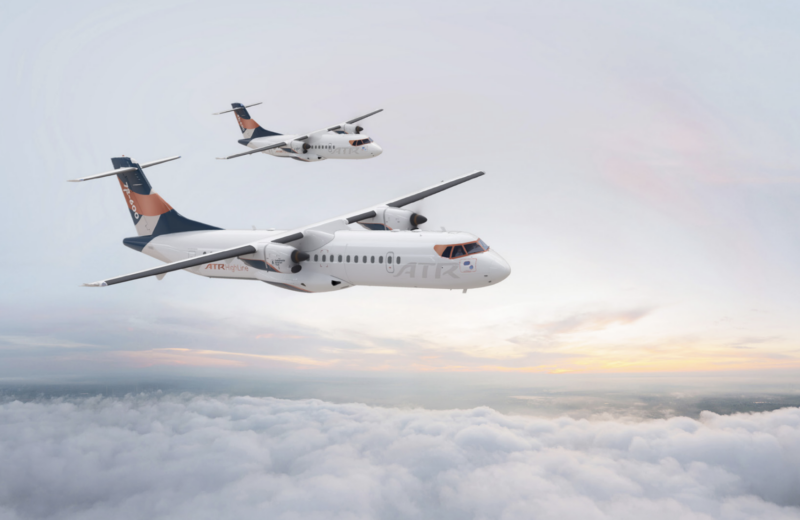
The company says the objective is to address an “emerging market opportunity” with new cabin products that leverage the “inherent strengths” of ATR aircraft.
French-Italian aircraft maker ATR says it is not competing directly with the traditional business jet or turboprop markets with its HighLine luxury cabin range.
“We address dual-class, corporate, semi-private and governmental mobility needs,” says Louis Barral, customer marketing manager for VIP Markets at ATR, speaking to Aircraft Investor. The company believes this niche is underserved by existing business aviation services.
When not abbreviated, what Avions de Transport Régional does best is what the company was intended to do from the start. The manufacturer was founded in 1981 as a joint venture between Aérospatiale (now Airbus) and Aeritalia (now Leonardo) to produce efficient regional turboprops. It has since delivered more than 1,700 aircraft.
The firm has two aircraft families: ATR 42 and ATR 72. These planes are often found operating routes in harsh environments and developing economies thanks to their operating economics and ability to access to short, remote airstrips.
HighLine cabins
But, in 2023, ATR revealed a range of high-end cabin configurations: Dual-Class, Premium-Flex, All-Business and Governmental. Each cabin is designed around niches the company has identified.
“ATR HighLine combines a premium cabin experience with the proven strengths of the ATR platform,” says Barral.
For the corporate market, it is targeting corporate shuttle operations for larger passenger groups otherwise accommodated by a bizliner. For governmental customers, it offers multi-section cabin layouts accommodating large delegations.
“We are also supporting the emergence of the semi-private market,” says Barral. “Once people step on board, they quickly realise that premium travel is not defined by the propulsion system but by the overall passenger experience.”
ATR isn’t worried about losing out to purpose-built business aircraft. It says the foray into the luxury segment is backed by demand. It also has decades of experience delivering VIP configurations for governments.
“There is no change to ATR’s core business which remains focused on commercial passenger regional transport and cargo operations,” says Barral. “Our decision to enter the high-end aviation segments is demand-driven … We have observed a shift in the demand emerging from private and charter commercial companies, seeking diverse premium products … positioned between traditional commercial aviation and business jets.”
The company says the objective is to address an “emerging market opportunity” with new cabin products that leverage the “inherent strengths” of ATR aircraft.
Berjaya Air and Air Tahiti pioneer concept
Malaysian private carrier Berjaya Air, which offers a by-the-seat business class experience and private charters to resort destinations including Redang Island and Koh Samui, is pioneering the HighLine configuration alongside Air Tahiti.
Berjaya took delivery of the first ATR 72-600 with an All-Business Class cabin in May 2026, accommodating 26 seats in a one-by-one layout. A second aircraft in the same configuration is set for delivery before year end.
“They are demonstrating how premium ATRs can support premium shuttle services, regional charter operations as well as scheduled semi-private services,” says Barral. “The resort and leisure market is certainly one of the addressable segments and these first two operators illustrate that very well.
“However, it is not the only market we are targeting as ATR HighLine was designed around several distinct use cases.”
JSX adds ATRs to fleet
Public charter carrier JSX, which sells by the seat, signed a letter of intent for up to 25 ATR aircraft in ATR HighLine configuration at the 2025 Paris Air Show. It began operating two ATR 42-600s in December last year.
ATR says the per-seat charter model used by JSX which bridges the gap between scheduled and general aviation, partly inspired its luxury bet.
“Their model demonstrated that there is a growing segment of passengers willing to pay for a more exclusive and convenient regional travel experience while still benefiting from the economics of scheduled operations,” says Barral. “At the same time, we were also receiving increasing interest from a broad range of customers for more premium ATR cabin solutions. ATR HighLine was therefore developed as a response to several converging market signals, of which JSX was certainly an inspiring example.”
JSX’s ATR 42-600 aircraft are configured to their own specifications inspired by their Embraer ERJ regional jet fleet. It now has four ATR tails in the fleet with plans to add more.
Airbus partnership
ATR is working with sister company Airbus Corporate Jets to design its premium cabins. The luxury bizliner OEM is supporting development of the X-Space Table, a seating solution that converts a standard dual economy seat into a single business class seat. The modular design allows operators to switch between full economy and business class configurations in a few minutes.
“ACJ is bringing valuable expertise in premium cabin design, customer experience and customisation. This collaboration is a natural way to share best practices and create synergies between our organisations that both belong to the Airbus group,” says Barral.
Air Cambodia was announced as a launch customer for the X-Space Table, certification is expected in Q1 2027.
‘Minimising industrial impact’
ATR says a guiding principle behind HighLine has been to diversify the product offering while minimising its industrial impact. In many cases, ATR delivers a standard aircraft that is subsequently modified through supplemental type certificates and Part 145 installations carried out by approved external partners.
“This approach tends to provide greater flexibility for customisation,” says Barral. “For other solutions, such as the Premium-Flex configuration featuring the X-Space Table, development is being conducted internally by ATR. Ultimately, each solution is evaluated on a case-by-case basis to determine the most appropriate development approach for both the customer and ATR.”
Broadly, ATR believes aviation is undergoing a “gradual premium-isation” across multiple segments.
“Regional aviation is no exception,” says Barral. “ATR HighLine is our response to that trend … The experience we are gaining today is undoubtedly helping us better understand what premium regional aviation could look like tomorrow.”