


‘A great opportunity for business aviation’, and ‘we’re building it’ says Electra
Electra’s research has identified a customer base partly amongst business travellers.
In downtown New York but have to visit the shop floor in a facility upstate later that day? Just out of back-to-back afternoon meetings in Tampa and need to make it to West Palm Beach in time for dinner? The choices are limited. Many aircraft are too inefficient and costly for such short distances, which makes hitting the road (and quite possibly being late) the only viable option.
US-based hybrid-electric short take off and landing (STOL) aircraft developer Electra just published its Direct Aviation Market Outlook report outlining the potential to capture the market of trips from 50 to 250 miles.
Its research – using location-based data including pings from cell phones, cars and credit card usage – found there are more than 33m daily passenger trips in the US between 50 and 250 miles. Of which, a “minuscule” amount are served by business aviation.
“Our research shines a bright light on how large the opportunity is that we as the aviation industry are leaving on the street right now,” Diana Siegel, vice president, commercial at Electra tells us.
“If you look at aviation offerings, you can either buy an economy ticket for $150 to go from New York to [Washington] DC, but you’ll still spend four hours because you have to go to and through two major airports,” she continues. “Or you drive four or four and a half hours. Or if you’ve got a lot of money, you can get a $10,000 private jet. But in between, aviation doesn’t offer anything.”
According to the report, some routes have coverage of 15% by air, but 85% of the routes Electra found aren’t covered by aviation services. In that 50 to 250 mile segment, less than 1% of trips go by air. “If you zoom into how many of those 33m people are actually going by private turboprop, piston or jet, it’s a tiny, tiny fraction,” she says.
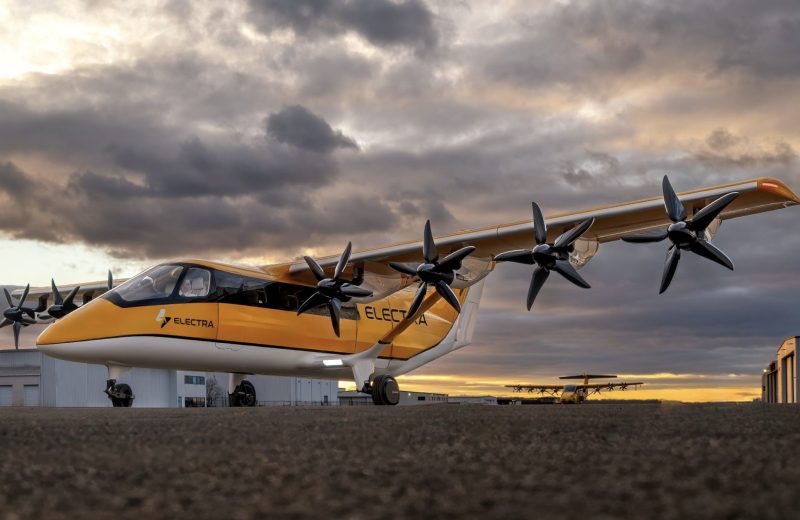
Electra, which is developing a nine-passenger hybrid-electric STOL aircraft that makes use of blown-lift technology to enable takeoffs and landings in 150ft or less, sees its aircraft known as EL9 “largely complementing” business aviation.
“Business aircraft tend to be on 300-mile-plus routes,” says Siegel. “The heart of the market and the real opportunity for Direct Aviation is in that 50 to 250 mile range, where if you have the overhead of going to and through an airport, most people choose to drive because access time negatively affects door-to-door trip time.”
But Siegel says there is real overlap with turboprop and high-powered piston segment. “Whether you use a Cessna Caravan or to some extent a PC-12, there’s overlap in that 150 to 250 mile segment. However, the much larger market in that Direct Aviation opportunity is where neither a Caravan nor a PC-12 would compete well, because it’s all about access and quiet,” she explains.
“So there’s a larger opportunity there than what’s already tapped by turboprops,” she adds.
It is a good point. Business aviation users choose to fly privately rather than use commercial airlines overwhelmingly because of time savings. A 2024 survey by SkyShare found that 77% of respondents cite time-saving benefits as the reason why they use business aviation, and 35% highlighted the importance of spending more time with family.
Siegel says electing to fly on a non-scheduled service from a smaller airport can help to some extent, but further time savings could be realised using Electra’s EL9.
“For New York to DC, if I go from Manassas to Teterboro, on each end I still have another hour to get where I actually want to go,” she says. “Yes, you slice out an hour, but you’re going down from four hours to three. What you really want is to cut travel time in half and get down to two hours. That’s the entire thesis of Direct Aviation – get people closer to where they want to go to provide significant value in time savings and convenience.”
Electra’s research has identified a customer base partly amongst business travellers. Its pricing assumptions rest on operating costs of about 75 to 85 cents per seat mile, turning into a customer price of roughly $1.50 per seat mile. That would put a ticket between New York and DC at $300 to $400 depending on the operator’s pricing.
“That’s an order of magnitude less than chartering a private aircraft,” says Siegel. “Particularly on New York to DC, you could comfortably fill a nine-passenger airplane every hour or every 30 minutes, with over 10,000 passengers travelling that route every day on the ground.”
The pricing Electra projects is comparable to what you pay for an Uber per mile, or for a business class ticket on the same route. “It should attract the typical business traveller for whom any time saved is significant. Plus for people doing inner-city or leisure travel on a semi-regular basis, it’s a price point that some can afford habitually, but also one that’s affordable for everyone sometimes,” she says.
Electra will act strictly as an OEM and plans to sell its aircraft to operators and offer aftermarket services. List price for the EL9 is $10m, but discounts are available for early and multi-aircraft orders. The developer has amassed orders for 2,200 aircraft from a variety of customers, including JSX, which signed a letter of intent for up to 82 aircraft, and Surf Air, which has secured early delivery positions 90 aircraft.
Surf Air sees a substantial opportunity in the 50 to 250 mile market. A spokesperson for the company tells us: “We are positioned to capture it through the assets we already operate: one of the largest US commuter airlines by scheduled departures, an on-demand charter marketplace and our SurfOS creating the digital infrastructure that give us the network, operating data and technology platform to convert that demand into accessible point-to-point service.”
The firm’s SurfOS is an AI-enabled operating system developed by Surf Air in partnership with Palantir. Designed to digitally optimise regional aviation, it integrates scheduling, routing and operations into one platform and is available to independent charter brokers, airlines and owners.
Like Electra, Surf Air sees electrified aircraft as complementary rather than competitive. “Their short-field access and lower operating costs can let us serve communities and airfields conventional turboprops can’t reach economically,” says the spokesperson. “Any overlap is additive as next-generation aircraft integrate into our operating platform. We think about fleet integration as the right mix, not a winner-take-all replacement.
“For business aviation, electrified aircraft will open entirely new routing options closer to where passengers actually need to be. Through our own operations and with our SurfOS software, we can help other operators integrate these new aircraft intelligently.”
The selling point for operators and passengers alike, Electra believes, lies in its ability to deliver users unprecedentedly near to their final destination by air.
Last week, the developer completed the first urban demonstration of its technology demonstrator aircraft at the Columbus Street Terminal in Charleston, South Carolina. Operating from the ro-ro cargo terminal on the banks of the Cooper River puts Electra within 1.5miles of downtown, versus 12miles from Charleston International Airport.
“As an aviation industry, we’ve done a beautiful job of connecting us all across the globe,” says Seigel. “Where we’ve done a not-so-great job is connecting our regions. You might argue we’re doing a worse and worse job, concentrating more and more routes through fewer and fewer hubs.”
The Direct Aviation report frames Electra’s ability to deliver this as the “rule of six”.
Seigel explains: “To really save people hours off their travel time, not just minutes, you need payload and range. You need to be affordable and safe. Fixed-wing does those four really well. What they don’t have is the accessibility and quietness – the ability to get into close-in urban settings to take out that overhead and save people hours.”
With Electra eyeing service entry for the EL9 in 2029, being late could become a thing of the past. Well, at least using the excuse of traffic should.
Subscribe to our free newsletter
For more opinions from Aicraft Investor, subscribe to our One Minute Week newsletter.