


Whisper Aero launches JetFoil and potential promise of making aircraft ‘runway independent’
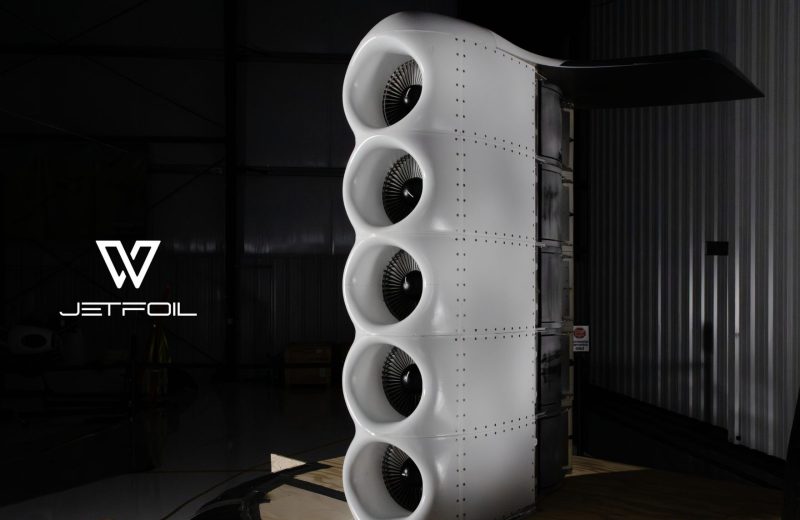
Whisper Aero's development team claims it has not been able to get the JetFoil wing to stall during testing.
Electric propulsion systems developer Whisper Aero has found itself at the leading edge.
Announced at SAE AeroTech 2026, Whisper’s new JetFoil technology integrates its electric ducted fans into the leading edges of wings, enabling conventional, short and vertical takeoff and landing in the same form factor without complex tilt mechanisms or separate lifting propulsion systems. Essentially, aircraft become “runway independent”.
The technology, currently in development at NASA technology readiness level (TRL) five, will be available for clean sheet aircraft and retrofit. During a presentation given by CEO Mark Moore today at SAE AeroTech 2026, a rendering of a fixed-wing turboprop retrofitted with JetFoil was included, hinting at the potential for today’s fleet to be upgraded.
The announcement also coincided with Moore’s acceptance of the V/STOL F.E. Newbold award from the American Institute of Aeronautics and Astronautics, recognising outstanding contributions to the advancement and realisation of powered lift flight.
Currently in ground testing, Whisper says its JetFoil technology represents a significant engineering breakthrough because it enables the entire wingspan to be blown through an array of propulsors without introducing heat, swirl, turbulence or additional parasite drag.

NASA’s QRSA taking off from an aircraft carrier with marks from the hot exhaust clearly visible on the wing.
The idea isn’t new. One of the first aircraft Moore worked on during his time at NASA was its Quiet Short Haul Research Aircraft. Under development in the late 1970s, the goal was to enable short takeoff and landing capabilities. Testing included taking off and landing on aircraft carriers and in and around contested environments where long, well-maintained landing fields are scarce.
Being the ‘70s, QSRA was powered by four prototype Avco Lycoming YF102 high-bypass turbofan engines, originally from the Northrop YA-9 programme. The aircraft is instantly recognisable with turbofans set in front of the wing to allow the expelled jet of air to make its way over it. NASA even had to reinforce the wing due to the hot exhaust melting the upper surface.
That lack of ability to distribute and embed propulsion technology along the wing was a big reason why the project never got out of development. Four decades later and Whisper believes it has the answer in its electric ducted fans.
Unlike turbofans, propellers, or other forms of electric propulsion, Whisper claims its electric ducted fans are scale invariant with respect to thrust. They operate at low engine pressure ratios for levels of propulsive efficiency greater than 90%, even at high speeds and compact sizes. The fans also feature low swirl which generates more concentrated thrust. The combination of these features enables greater levels of distribution without losses in power or additional noise.
Ian Villa, chief product officer at Whisper Aero, tells us the aim is to begin flight testing in the next 12-18 months.
“We’ve built out multiple of these JetFoils,” he said. “Our goal is to get to TRL seven, which would imply that we’re flying them. Work is underway to actually get these fully flying. We have internally some captive rigs where we’ve done tests. The goal is to move to fully releasing all the constraints and letting the first Jetfoil aircraft fly.”
The jets exhausted from the array of propulsors that make up JetFoil combine into a clean and uniform jet sheet. As it accelerates air over the upper surface of the wing, it creates a passive lift augmentation solution that Whisper claims is “stall proof”.
“This resulting blown wing is highly resistant to gust or turbulence, achieving max coefficients of lift as high as 40 at 15 knots for aircraft with a thrust-to-weight of 0.5 and wing loading of 25 lb/ft,” the company stated in a press release.
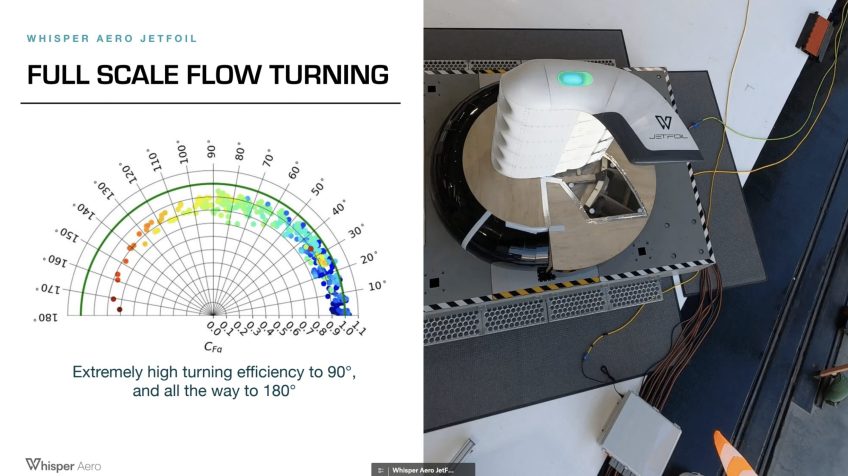
The highly uniform exhaust allows for Coanda flow turning with natural flow attachment. Villa explained: “Even at 90 degrees of flow turning, we can achieve over 90-95% flow turning efficiency. As you start to pull the flap back and look at ultra-short or short takeoff and landing, you get back to 98% turning efficiency. When you’re fully in cruise, there’s none of the turning loss. All of the efficiency is baked into the actual engine itself.”
Whisper claims this is in “stark contrast” to other VTOL propulsion technologies that redirect air with complex tilting propulsors like the V-22 Osprey, forcefully redirected flow with systems of flaps, or both as was attempted by Lilium.
“Imagine an aircraft with this wing in cruise mode, expelling thrust,” said Villa. “As you get closer to the ground, you deploy the flap, the flap starts to rotate that air downward. If you had a VTOL aircraft, you would be able to turn that flow all the way around, and now you’ve got net thrust coming out. It doesn’t require complex tilting. Instead, it just utilises a very simple flap and coaxes the flow to naturally rotate downward.
“90 degrees of turning has never been seen in literature or anywhere else,” he continued. “It’s achievable because we’ve made pure advances in our core electric propulsion technology and then solved some of the shape optimisation and other factors that allow you to rotate the flow down.” NASA research with QSRA was only able to achieve 100% turning at 45 degrees, before it experienced a precipitous falloff.
Whisper believes this robustness enables an array of new runway independent aircraft and operational capabilities. It enables near-VTOL flight with a 50-inch ground roll to follow typical helicopter takeoff and landing profiles that clear a 50 ft obstacle in less than 300 ft of horizontal distance. The company said that ground roll avoids the need to take off in a powered lift mode that forces aircraft to generate 1.2 times the thrust of the aircraft’s maximum weight.
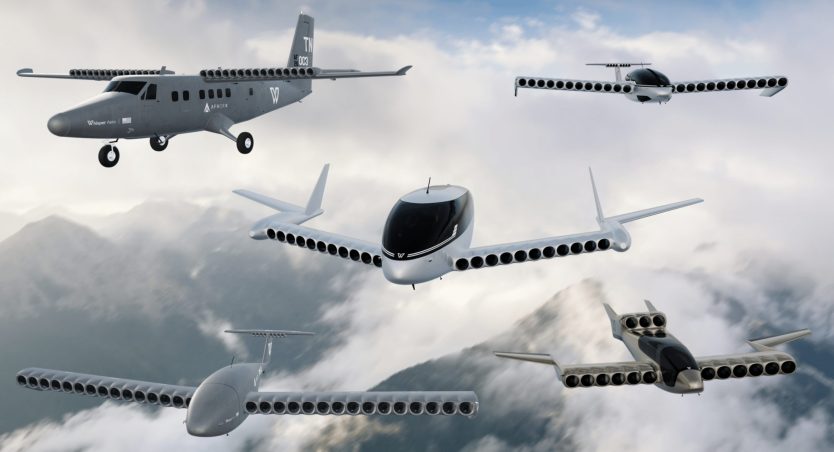
Whisper intends to develop JetFoil technology for a variety of aircraft, from uncrewed drones and air taxis through to crewed turboprops and other fixed-wing aircraft.
Using uncrewed aircraft systems (UAS) groupings as a marker – the US DoD classifies UAS into five groups based on maximum gross takeoff weight, operating altitude and airspeed – Villa said Whisper’s goal is to show that JetFoil works for group two, three, four, five and manned aircraft.
“We already have a captive demonstrator in-house that has shown how this would get utilised on a group two drone,” he said. “Our full-scale rig is utilising our larger propulsors, which are rated for group three, four and five. At half-span, it would fit a large group three, maybe a small group four. But you could conceivably see how you could have this Jetfoil on a nine-passenger airplane with multiple propulsors on it to generate more thrust.”
While it has engaged the FAA on this concept, the go-to-market is primarily in the defence sector first, confirmed Villa. Whisper has multiple contracts to continue to test and validate its propulsors and JetFoil on the ground and in flight together with the US Air Force, US Navy and NASA. This includes developing the capability for the Defense Innovation Unit Runway Independent Maritime & Expeditionary Strike (RIMES) programme in partnership with California-based startup Mach Industries.
That said, it is also partnering with OEMs to build and fly aircraft prototypes propelled by JetFoil over the coming year.