
Avincis chief: Europe must increase aerial firefighting capacity
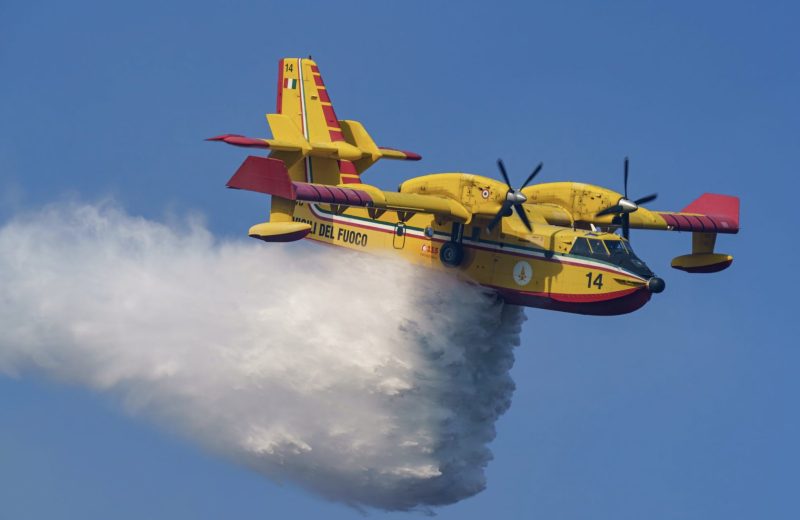
Boag said if he was in government, he’d be placing large orders for firefighting aircraft, treating it like a military challenge that requires sustained investment to meet a “growing threat”.
He hopes he is wrong, but if Europe does not scale its aerial firefighting capacity there will likely likely be more large fires causing greater property damage and potentially more loss of life, says John Boag, group CEO of Avincis.
The emergency aerial operator, the largest in Europe, recently published a report entitled Up in flames: The challenges of fighting wildfires from the air in a hotter Europe detailing the dire situation facing firefighting efforts as wildfires expand in size, duration and ferocity.
“Fires are becoming more intense,” Boag told Aircraft Investor. “I wouldn’t say ‘more aggressive’ – that’s probably not the right word – but there’s certainly more demand. They spread more quickly, and there seems to be a lot more fuel. Conditions dry out much faster.”
Boag said what used to be considered “normal” is changing. “You can see in the report the shift between what was normal previously and what’s happening now, including the increase in area burnt. Seasons are becoming longer, harder and more intense,” he explained.
Back-to-back fires in 2025 brought these challenges into sharp focus globally. In January, in Southern California wild fires caused 12 deaths, burned 9,500 hectares, destroyed almost 7,000 structures and caused $26.5bn in economic damage. Two months later, fires decimated parts of South Korea with 32 deaths, 48,000 hectares burned, 4,000 structures destroyed and economic damage around $8bn.

Boag said fleets need to “get ahead of the curve” in boosting firefighting fleet numbers.
Boag said the situation in Europe is no less troubling. There has been a 135% increase in burned area since 2014, while 2025 was the most destructive year on record, with over one million hectares burned across the continent.
Aerial wildfire fighting efforts are quickly arriving at the point where it becomes permanent infrastructure rather than a seasonal emergency. “I think we’re almost there,” said Boag. “Globally, fire seasons in both hemispheres are getting longer, which reduces the time available to move aircraft between them. You also have to factor in maintenance – every aircraft needs annual servicing.
“It’s becoming harder to move aircraft by ship in the available time, so the only option will increasingly be to airfreight them between hemispheres. But that’s extremely expensive.”
Long-term planning required
Seasonal firefighting means many contacts are short-term, often in the region of one or two years and covering only part of the season. But scaling up availability for firefighting aircraft is not a simple process, said Boag.
“Aircraft and specialist capabilities aren’t something you can just pick up off the shelf. Pilots need training, aircraft need preparation – it all takes time and investment,” he noted. “Until there’s longer-term thinking, availability will become a real issue.
“Operators need advance notice to prepare. Yet contracts are often awarded very late – sometimes even after the season has started. That puts governments at risk of losing access to aircraft altogether, because operators need certainty and will deploy assets elsewhere.”
Nevertheless, more aircraft, particularly fixed wing assets are needed. According to Boag, every season there’s a last-minute scramble for additional capacity. But the issue compounds as new assets coming online are often simply replacing ageing aircraft reaching retirement.
“Fires are increasing dramatically, but if you’re simply replacing aircraft one-for-one, you’re not getting ahead of the curve,” said Boag. “If fleets don’t grow, while fires become larger and more intense, the gap will only widen.”
European regulations stifle pilot numbers
Although he admitted it is a global issue, Boag said Europe makes it particularly difficult for pilots to enter and operate.
Boag’s son recently obtained an FAA licence in the US in about a month. “But to convert that to Europe, he’d need to sit 14 exams again, in person, with delays between them. It becomes economically unviable,” he explained.
At the same time, Boag said European pilots are leaving for better pay in regions like the Middle East and Africa. Military retention is increasing, so fewer pilots are entering the civilian market. Also, language requirements further restrict mobility. “All of this means we can’t bring people in fast enough, and the system is effectively holding the industry back,” he added.
The answer again is long-term planning. Training a co-pilot takes around two years, but to reach a captain level in a medium twin-engine firefighting helicopter can take eight to ten years, said Boag.
“It’s a long pipeline. Ideally, you’d bring in already experienced pilots, but they still need firefighting-specific training, which only comes with real-world experience,” he explained.
Technician shortage could be more pressing
While attention is often focused on pilots, maintenance technicians are just as important to keep the firefighting fleet in the sky. Avincis runs a global recruitment pipeline which translates into “highly international” hangars with technicians from Colombia, Peru, Angola, Poland and elsewhere, said Boag. “Without that, we simply wouldn’t have enough people,” he added.
The focus needs to be international because it is even harder to train technicians than pilots, he noted.
“I personally think the demand for technicians is going to be far more than pilots and far more difficult,” Boag said. “Here’s a simple thing, sheet metal technicians, that’s a true skill, it takes them a long time to become adept at what they do. That is not something that can be easily replaced.
“We’ve got to encourage the youth, the next generation, it’s our job to ensure that we can bring them on and educate them and grow them up,” he added.
Bureaucracy and regulation ‘key barriers’
For many reasons, governments often default to reactive measures in the face of immediate pressures rather than planning ahead. But given the long lead times, they need to get ahead of the curve, said Boag.
The EU does at least recognise this. In the same week — and nicely timed with Avincis’ report — it released a new wildfire strategy which puts increased emphasis on fire prevention.
Teresa Ribera, executive vice-president for Clean, Just and Competitive Transition said: “The number and intensity of wildfires across the continent is worryingly increasing, destroying ecosystems and infrastructures, impacting on people and the economy. Strengthening our prevention and resilience capacities and investing in healthy ecosystems will help us to reduce the most dangerous risks and lower the costs and damages.”
The EU also plans to expand its rescEU firefighting fleet with 12 firefighting aircraft, as well as five helicopters. The first helicopter of the rescEU fleet, delivered to Romania in January 2026, will be ready for the 2026 wildfires season, it confirmed.
“That shows the issue is recognised,” said Boag. “But unless capacity increases alongside demand, the situation will worsen.”
Boag said if he was in government, he’d be placing large orders for firefighting aircraft, treating it like a military challenge that requires sustained investment to meet a “growing threat”.
He would also streamline entry for professionals from countries with equivalent standards under ICAO – such as the US, Canada and Australia. “Basic qualifications should be recognised. Aerodynamics is aerodynamics, performance is performance. It doesn’t make sense to require full re-examination,” he said.
Finally, Boag advises European administrations to increase their reliance on commercial operators. “In my experience, commercial operators are more cost-effective,” he said. “They have a commercial incentive to operate efficiently, whereas government agencies often don’t have the same pressure.
“Yes, the military do a lot of firefighting in some regions. Which is fine, they get very good training. But in the event there is a global crisis, is that capacity still going to be there?”